 Convenor
Dr. Kevizakielie Suokhrie
Convenor
The Research & Development Cell of Oriental College was added to the list of the existing clubs and committees in 2023 to promote and facilitate research activities among faculty and students alike.
In line with the NEP 2020, the College, through the Research & Development Cell, aspires to inculcate a culture of academic research in the learning process. The Cell aims to create and support research-oriented activities, so that research is well structured and aligned with the academic goals of the College.
To build and enhance the research ecosystem of the college.
To develop scientific temper and critical thinking among the student community.
To promote academic research among the faculty and students.
To preserve the code of ethics of the college while publishing.
To coordinate and oversee research programmes for both faculty and students.
To integrate emerging trends and multidisciplinary research methods, encouraging researchers to explore new and innovative research topics.
The Cell was reconstituted on 29 April 2026 with new members for the tenure 2026–2029, to ensure the continuity of research-related activities and strengthen the research culture of the institution.
Convenor
Convenor

Member
Member
Member
To promote a vibrant research culture in the College and to encourage faculty members to engage in scholarly activities, the Faculty Research Forum was constituted under the initiative of the Research & Development Cell on 14 July 2026.
The Forum provides a platform for teachers to present, discuss and share their ongoing research, research findings and scholarly contributions, to exchange academic ideas, enhance research skills and foster collaborative learning. As part of its activities, the Forum holds a Monthly Faculty Research Presentation, in which one faculty member presents a research paper or shares research findings each month.
| Date | Presenter | Department | Moderator | Rapporteur | Report |
|---|---|---|---|---|---|
| Dr. Kevizakielie Suokhrie | Education | Mr. Setuolie Theünuo | Ms. Neikosenuo Kiso | Report | |
| Dr. Abeni Tsopoe | English | Mr. Nito Khulu | Ms. Limanaro Walling | Report | |
| Dr. Sedevinuo Kire | Tenyidie | Mr. Sojimon Thomas | Mrs. Vikeyienuo Rutsa | Report | |
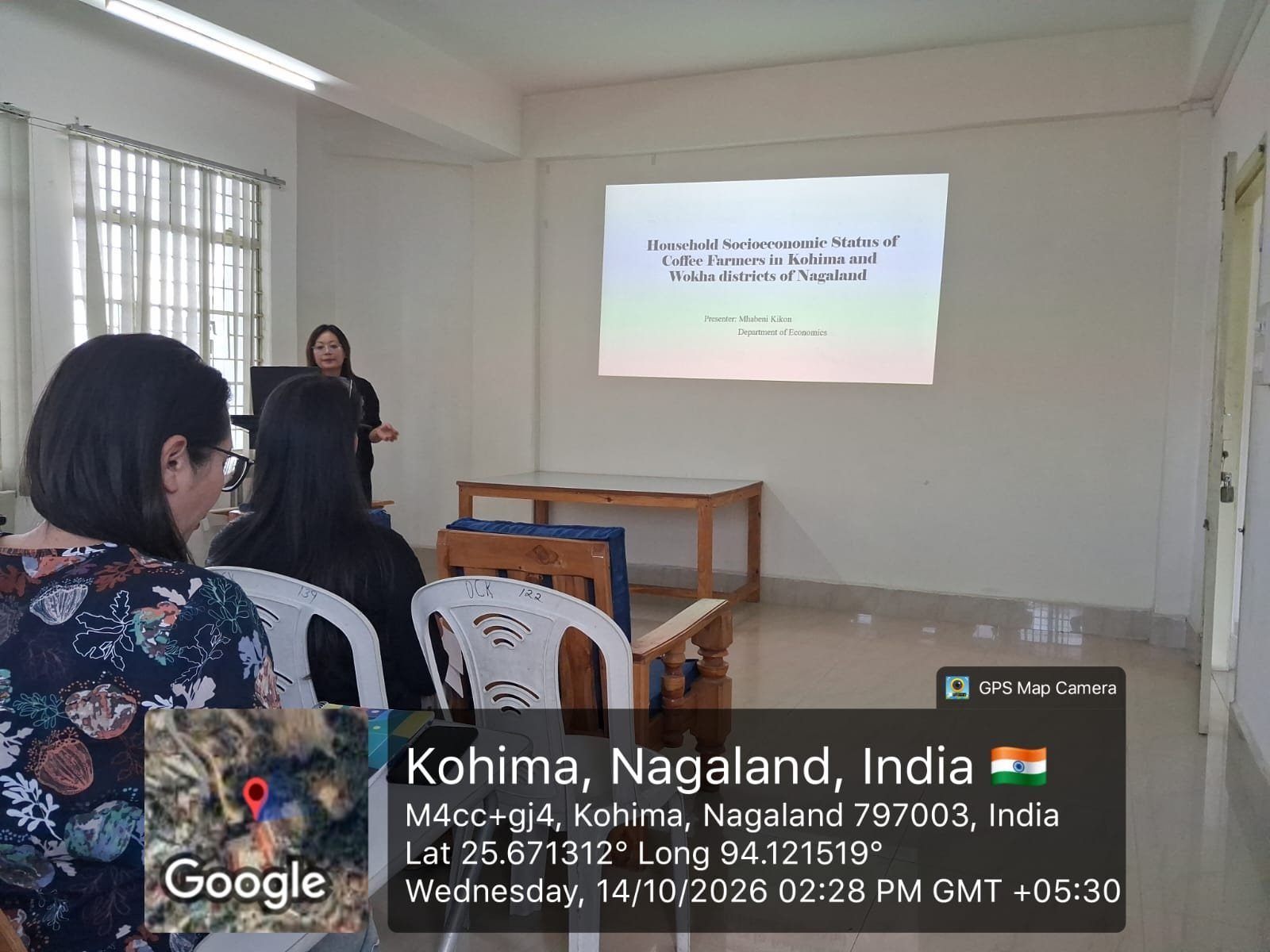
| Ms. Mhabeni Kikon | Economics | Ms. Rülevelü Cükhamu | Ms. Teisovinuo Kar | Report | |
| Mr. Tumben Ngullie | History | Mrs. Chubanenla Imchen | Ms. Gwasole Tep | ||
| Ms. Chibeni Murry | Political Science | Ms. Aboli Chikhe | Ms. Mesanuo Miachieo |
Each presenter prepares a PPT and presents a research paper (empirical, conceptual, review, case study or any other scholarly work, published or unpublished). All faculty members attend and take part in the discussions. Presentations start at 2:30 pm. Dates may change in the event of unforeseen holidays, institutional activities, examinations or other official programmes.
Reports of the Monthly Faculty Research Forum presentations, newest first.
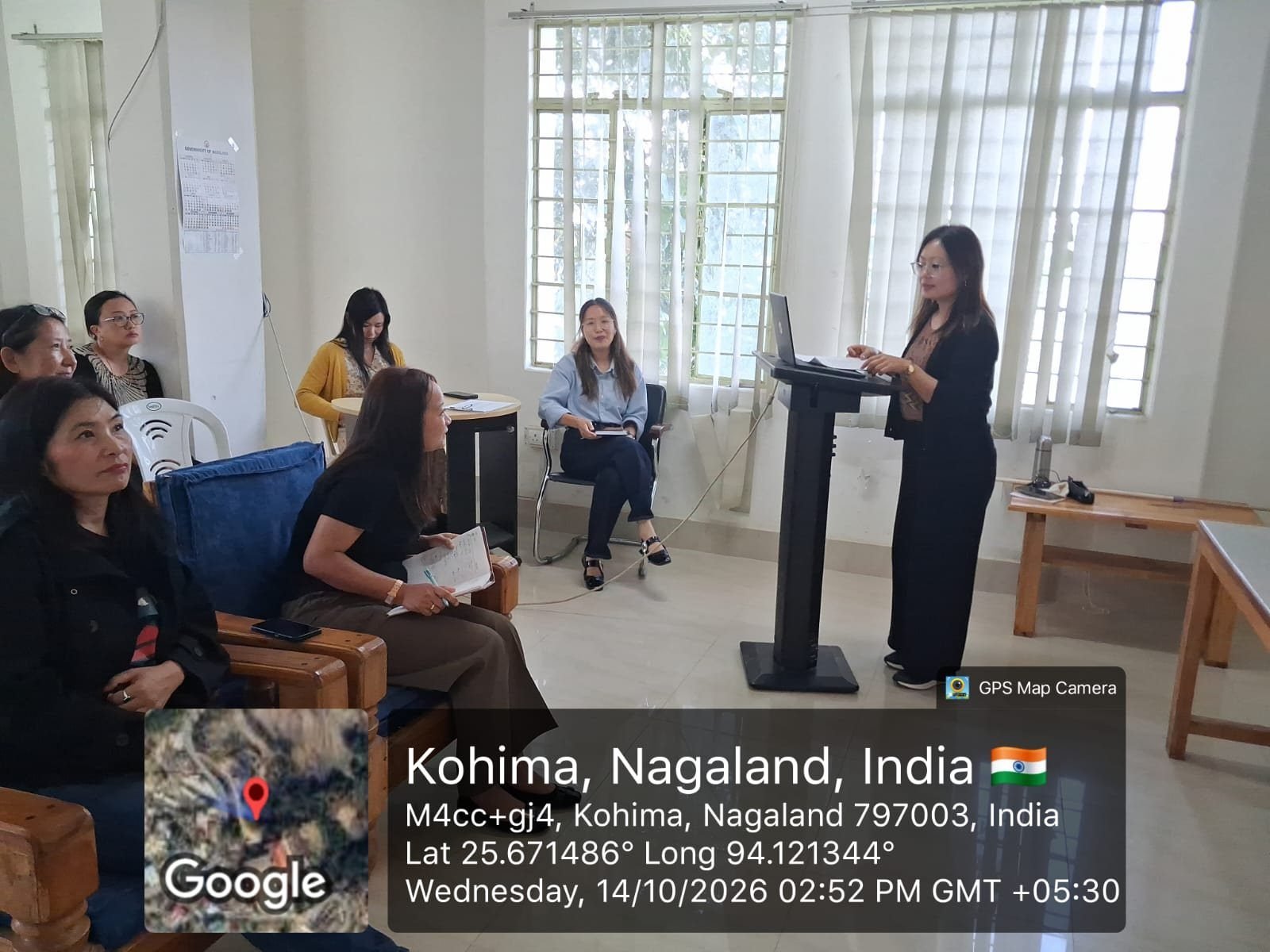
The paper examines the socioeconomic status of coffee farmers in the Kohima and Wokha districts of Nagaland, using primary data from 60 coffee-growing households in 14 villages, and finds that government schemes have little measurable effect on farmers’ income. The session was marked by active engagement, meaningful discussion and an interactive question-and-answer session.
The presenter began by introducing the importance of coffee plantations for their contribution to GDP and employment, and the currently identified number of coffee species (125).
Coffee was introduced in Nagaland in 1981 by the Nagaland Plantation Crop Development collaboration in partnership with the Coffee Board of India, and revived in 2014 through the Land Resources Department in partnership with the Coffee Board of India, aiming at specialty organic coffee, rural employment and a check on jhum cultivation. The area under coffee reached 10,202.2 ha in 2022–23. The study asks who is growing coffee and whether support schemes are helping.
The study used purposive sampling and surveyed farmers with a mix of open-ended and closed-ended questionnaires. Income was analysed by multiple regression in SPSS.
Existing government schemes do not majorly affect coffee production in Nagaland, and larger farms yield more. Nearly all farmers are men, while hired labour is mostly women. The progressive growers are largely salaried or retired people rather than full-time farmers. Farmers’ main concerns are fluctuating prices and weak market linkage. The presenter recommended shifting government support from production-centred to income-centred schemes, and credit, subsidies and promotion schemes backed by research and extension services.
The presenter concluded by updating participants on the current total area under coffee cultivation, 11,647.69 hectares, and the growing importance of coffee production in Nagaland.
The paper addresses a timely local question with primary data. The farmer profile (age, education, occupation, farm size) is clear, especially the finding that coffee cultivation is mostly a second occupation.
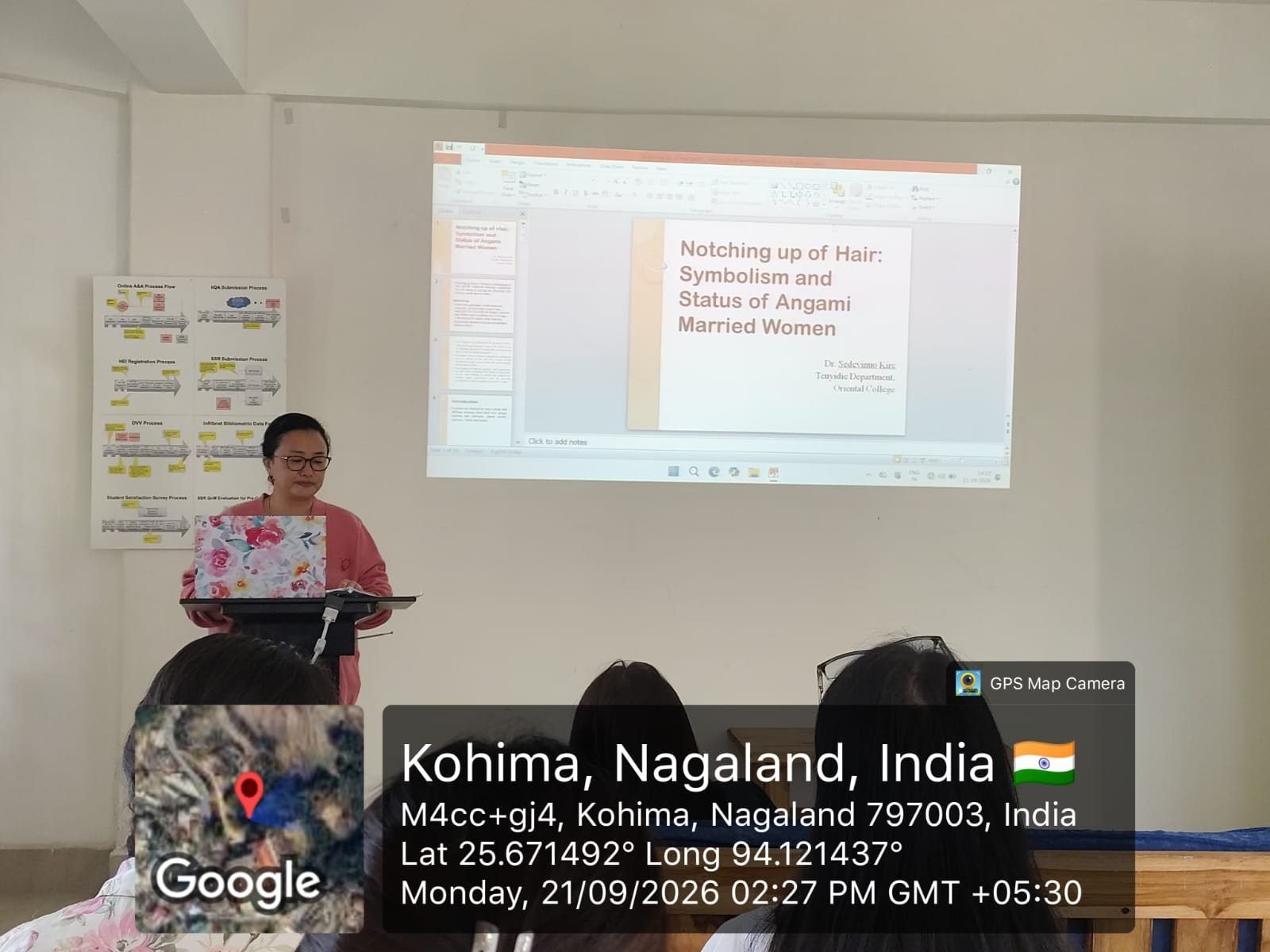
The paper, a chapter from Dr. Kire’s Ph.D. thesis, studies the traditional regulation of women’s hair among the Angami Nagas. Based on qualitative research through interviews and participant observation in fourteen Angami villages across the four Angami ranges, it looks at the custom through feminist theory. (All fieldwork, interviews, findings, vernacular terms and interpretations belong to Dr. Kire’s original research; the report is a summary written for academic reporting.)
Dr. Kire begins by stating that every society is known by its own customs and shared values. Among the Angami Nagas, one of the most distinctive customs was the regulation of hair for women. While hair is generally seen as a sign of femininity, beauty and self-identity, in traditional Angami society it was not a private matter but a social symbol governed by customary law.
In the past it was compulsory for an Angami girl to keep her head shaven from birth until her marriage was finalised. Allowing hair to grow before marriage was regarded as a serious taboo known as ‘kenyü’. Only after her parents accepted a marriage proposal could she stop shaving, and her newly grown hair became a public announcement that she was about to be married. Early writers such as Zhale and Hutton also documented this practice.
The shaven head signified that a girl was still unmarried and eligible to be courted, and was connected with notions of purity, chastity, virginity and innocence, believed to protect the honour of the entire community. Dr. Kire connects this to Carol Hanisch’s feminist slogan, “the personal is political”.
The rule was strictly enforced. A girl who grew hair before marriage was termed ‘kemethuotha’, a law-breaker; she was shamed and isolated, and her name was publicly announced to the village in a declaration called ‘pheshie’, followed by the observance of a genna, ‘penie’. Head-shaving was also used as a punishment for moral offences such as adultery and infidelity, with a parallel drawn to France after 1940.
Girls deeply yearned for long hair. During play they placed leaves on their heads as imitation hair (‘thala’) and made corn-husk dolls with long corn-silk hair, a longing captured in the ancient Tenyimia folk poem ‘Kiya ThaPfü’. The ritual ‘kharu ki nyi’, marriage to the village gate, allowed a woman to earn the status of a married woman, and permission to grow her hair, without marrying a man. Dr. Kire observes that the pressure may have been one reason for very early marriages and for frequent divorces (‘thakranhyü’) at the time.
Dr. Kire analyses the tradition as a form of patriarchal control over the female body: women had no control over their own appearance, and the community’s emphasis on shame (‘theciethenga’) placed the entire burden of purity on women, reflecting the discrimination and subordination raised by second-wave and socialist feminism.
A major turning point came with the arrival of Christianity in the Angami region in 1878 and the spread of modern education. Many early women converts were drawn to Christianity because it imposed no restriction on growing hair and preached equality before God. Particularly after the 1970s the status of Angami women improved greatly, and the practice has disappeared, marking a journey from customary control towards personal liberty.
Dr. Abeni Tsopoe presented a paper on postcolonial theatre as discourse, activism and resistance, taking the play I Will Marry When I Want by Thiong’o as her corpus. The paper treats ‘touch’ as extending beyond the physical to the emotional, ideological and political, and shows how theatre can both expose oppression and awaken resistance.
The playwright’s use of songs, movement and direct audience involvement breaks the fourth wall and makes the play participatory. In postcolonial literary critique, the politics of touch examines how oppressive political structures, religious dogmas and economic systems invade, regulate and do violence to the physical, psychological, spiritual and daily spaces of ordinary citizens.
The oppressive touch is the metaphor through which systems of power enter and control people’s lives: colonialism, neocolonialism and the class divide, with particular emphasis on Kenya, the setting of the play. The paper argues that political liberation has not brought economic freedom to the working class, as land, work and resources remain controlled by the elite. For working-class characters touch is associated with scarcity and survival; for the affluent it represents possession, comfort, wealth and authority.
Fanon’s theory shows that colonialism is not limited to political control but creates social hierarchies, economic inequality and psychological domination, which is crucial to understanding the play.
Religion possesses emotional and ideological power; religious touch becomes a metaphor for manipulation, dispossession and betrayal, and the paper examines how religious institutions intertwine with political and social structures.
Theatre becomes a form of liberation and reform: it breaks silences, awakens political consciousness and becomes a mouthpiece for social issues. The enduring popularity of the play shows theatre as a space to breathe for the oppressed and a reaffirmation of reality rather than an escape.
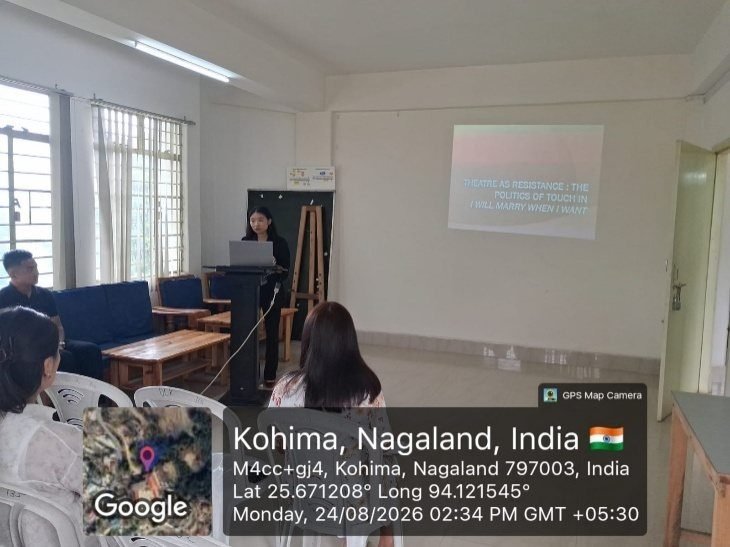
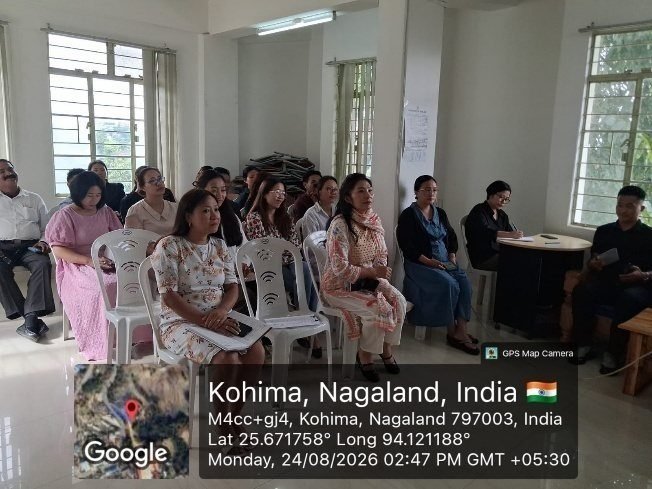
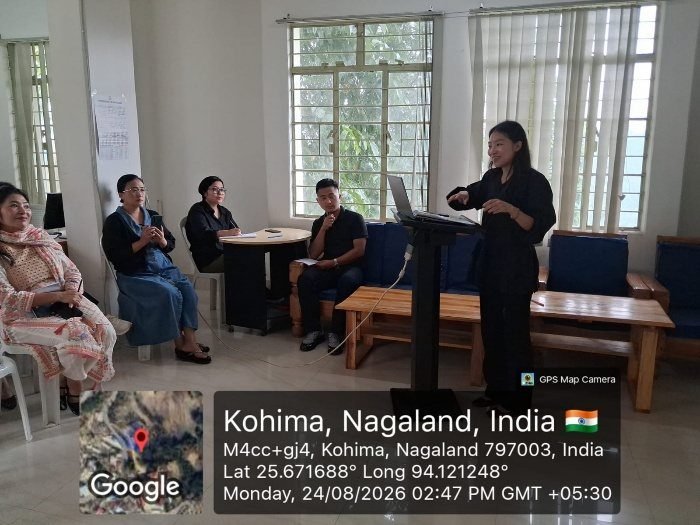
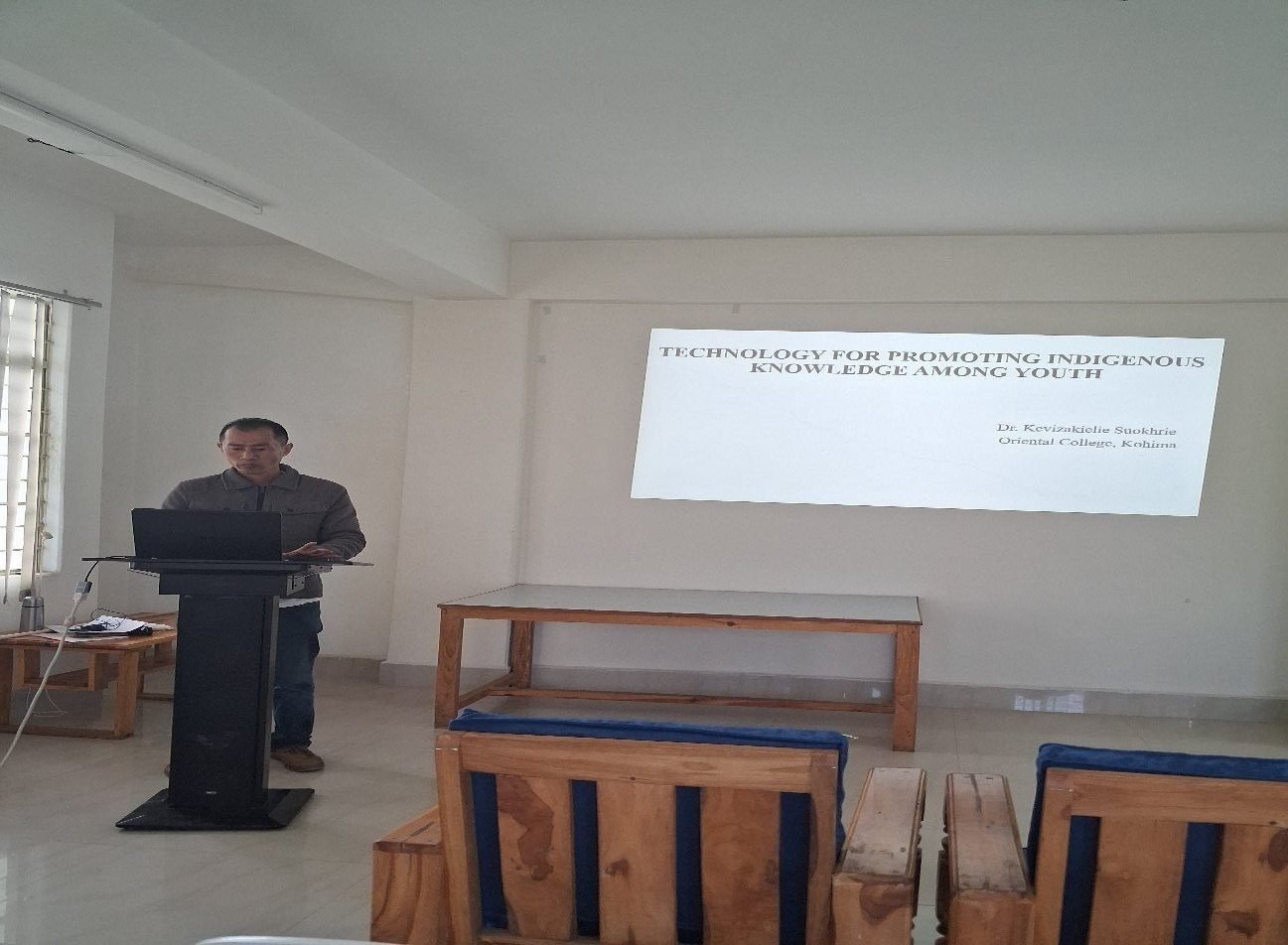
The first presentation of the Faculty Research Forum. Dr. Kevizakielie Suokhrie explained the concepts of Indigenous Knowledge and Indian Knowledge Systems (IKS) and their importance in preserving cultural heritage, traditional wisdom and sustainable development, and showed how technology can help safeguard and promote them among young people.
The presentation highlighted the growing challenges faced by indigenous knowledge due to globalisation, modernisation and digital culture, while noting that the National Education Policy (NEP) 2020 encourages the integration of IKS into education.
It discussed how technology can safeguard and promote indigenous knowledge through digital documentation, social media, mobile learning applications, Artificial Intelligence (AI) and Virtual Reality (VR), citing e-learning platforms such as SWAYAM, DIKSHA and MOOCs that can make such content widely accessible.
Key challenges discussed were the digital divide, language barriers, intellectual property concerns, and financial and technical constraints. Recommendations included integrating Indian Knowledge Systems into curricula, strengthening digital infrastructure, developing digital learning resources, encouraging community participation and enhancing teachers’ capacity.
In conclusion, the presentation stressed that technology should complement, rather than replace, traditional methods of knowledge transmission: combining modern technology with indigenous wisdom, while respecting cultural values and community ownership, can preserve indigenous knowledge and strengthen cultural identity among the younger generation.